














WP-PFManagement
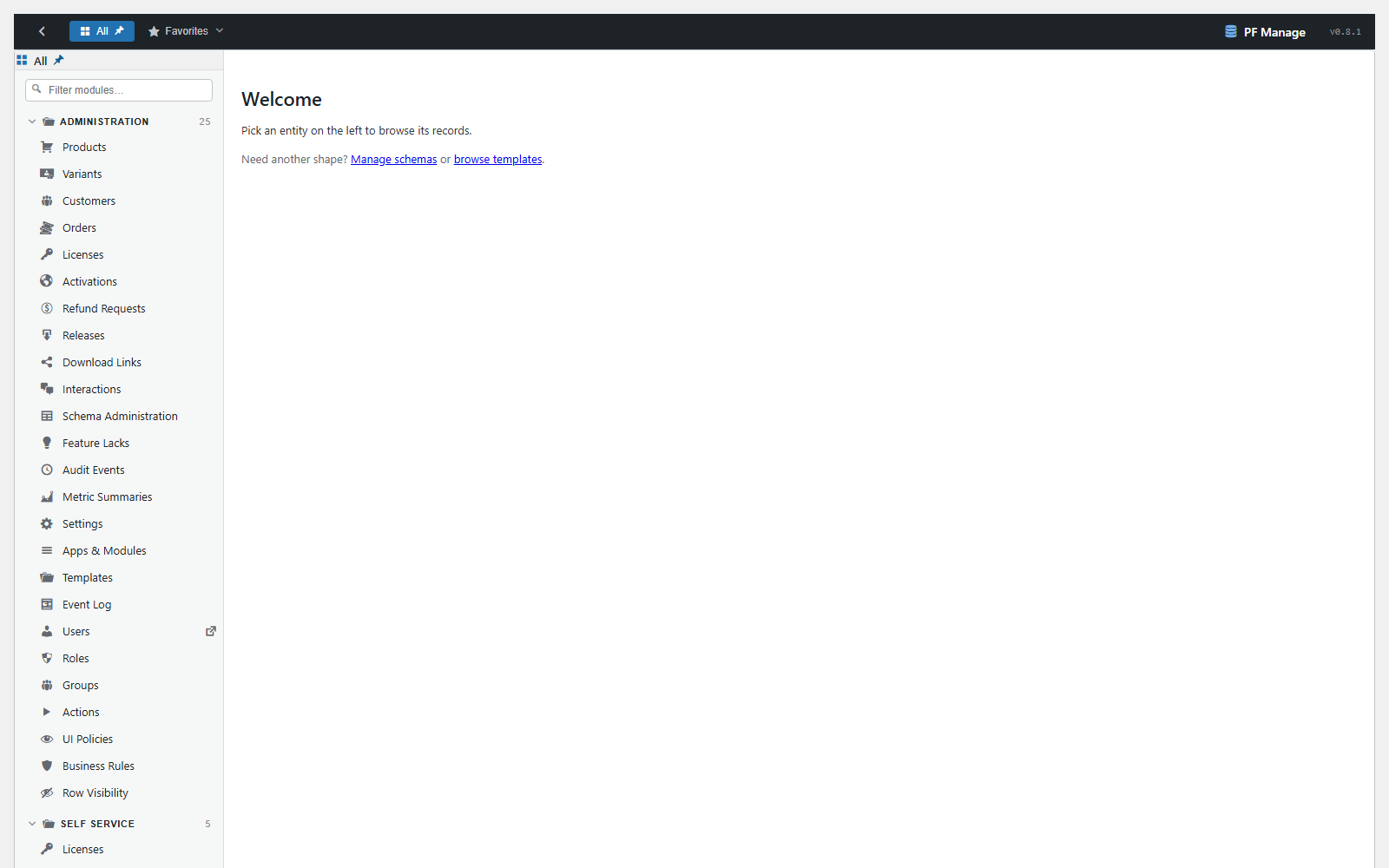
WP-PFManagement is a low-code application platform, native to WordPress. Without writing a line of code you model your processes, assets and services — entities, fields, forms, lists, permissions and business rules — and ship real applications (ITSM, CRM, asset/CMDB, service desk) inside your own WordPress. No external SaaS; your data never leaves your database.
You define entities (a record type with typed fields), a form to create / edit records, a list to view many records, and the engine handles storage, query, validation, and event emission.
It is the low-code platform of the three Setyenv plugins. Use it standalone to build real apps (CRM, helpdesk, inventory, project tracker). Pair it with WP-PFWorkflow to react to record events as native triggers. Pair it with WP-PFAgent to design entire schemas from a sentence.
What you can build with it
- Lightweight CRM: entities for Contact, Company, Deal, Activity; forms and lists for each; Workflow reacts to
pfm.record.createdon Deal to push to Slack. - Helpdesk: entities for Ticket, Reply, Customer; kanban list view by ticket status; Workflow auto-assigns based on keyword rules.
- Inventory: entities for SKU, Warehouse, StockLevel; CSV import on first install; Workflow fires when StockLevel drops below a threshold.
- Project tracker: entities for Project, Milestone, Task; relation fields linking them; kanban view by Task status.
- Custom apps: anything that fits the shape "a list of records, with fields, that users CRUD and react to".
What makes it different
vs. Custom Post Types + ACF: CPTs are fine for small things but degrade fast as you add fields, validations, queries, list views. WP-PFManagement gives you a real form designer, a real list view with EQL queries and saved views, real validation (not just text-input-and-pray), and native event emission.
vs. Airtable / Notion databases: those are excellent but they are external SaaS. Your data leaves your server. WP-PFManagement keeps it inside your WordPress.
vs. ServiceNow / Salesforce custom objects: orders of magnitude lighter. You don't need a six-figure annual contract to build "a list of things with fields that workflows react to".