














Clone — pulling down
Clone refreshes this instance from its superior. It only ever pulls down, never the other way, so a development site can be brought close to production without production ever being at risk from it.
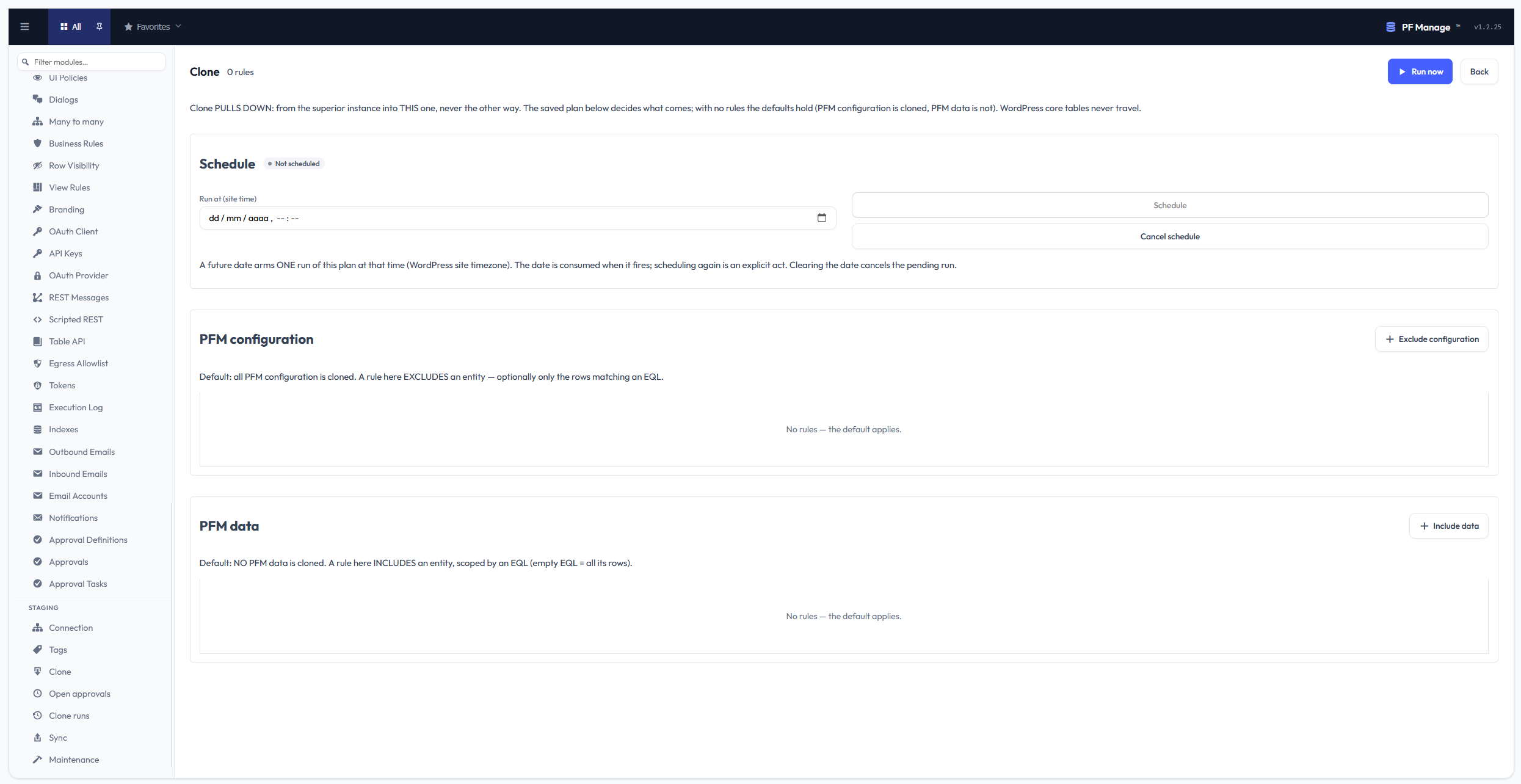
What comes by default
Two buckets, with deliberately opposite defaults:
- PFM configuration — the platform's own definitions: entities, fields, forms, lists, rules and everything that describes how your system is built. Cloned by default, because a development instance that does not match production's shape is not a development instance.
- PFM data — your business records: tickets, contacts, projects, orders. Not cloned by default, because production data has no business being copied onto a laptop just because somebody clicked a button.
With no rules at all, those defaults are the whole plan, and the plan page says so. And the staging configuration itself is skipped always: a Clone must never overwrite the very connection and plan that drive it.
The rules that change it
The plan holds two lists, and each one bends its bucket's default:
- Exclude configuration — names an entity whose configuration should not come down.
- Include data — names an entity whose records should come down, narrowed by an EQL expression. An empty expression means all of its rows;
status=openmeans only those. This is how you bring down the fifty tickets you need to reproduce a problem instead of the two hundred thousand you do not.
half-applied. If an exclusion rule carries an EQL, the entity travels
whole and the run item says plainly that the row-level part is not
implemented — never a filter that quietly did nothing.
Running it, now or later
Run now executes the saved plan immediately. The Schedule box arms exactly one run at a date and time in the site's own timezone: the date is consumed when it fires, so scheduling again is an explicit act, and clearing the date cancels a pending run. There is no recurring clone by design — a copy that lands on top of your work every night, unasked, is a trap rather than a feature.
What the run tells you
Every candidate leaves a line in Clone runs: done, skipped with the reason, or failed with the reason. The run header carries the totals — entities considered, records created, records overwritten — and a run that could only do part of its work ends as Partial, not as a green tick.
This is the contract: no silent truncation. If something did not come down, the run says which thing and why, and you can read it afterwards instead of discovering the gap weeks later.